
All Resources

Benefits of Screening
People identified early through screening programs have milder disease and better quality of life compared to control

The role of GWAS and GRS in T1D
Explore the association of GWAS and GRS and how they can improve T1D

The impact of GRS on T1D screening
GRS helps to select individuals at high risk for T1D for screening

Staging in T1D
T1D has three different stages, characterized by increasing loss of beta-cell function

CD8+ T cell Exhaustion as T1D Biomarker
CD8+ T cell exhaustion rate predicts progression of T1D

Islet Autoantibodies in T1D
The number, type, and titer of islet autoantibodies detected in T1D screening tests provide valuable information about potential progression to clinical T1D.

Monitoring Individuals with IAb Positive Status
Explore how clinical outcomes are impacted by screening and monitoring
.png/jcr:content/224SFAD0374_Etiology_infographics_thumbnail%20(2).png)
Exploring the Etiology of Autoimmune Type 1 Diabetes
Overview of the factors playing a role in the etiology of T1D.
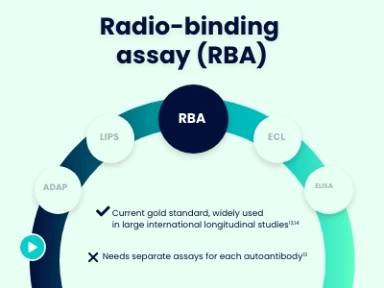
A Guide to T1D Screening Tests
A guide to autoimmune type 1 diabetes (T1D) screening tests.
IDS 2024 Symposium Summary
At the BR1DGE symposium at IDS 2024, leading experts shared new insights on the mechanisms driving autoimmune type 1 diabetes (T1D), emphasizing the benefits of genetic risk scoring, and the latest biomarker research.
This article is intended to be a summary only. Additional topics were covered in the live symposium in line with the applicable regulations but are not included on the BR1DGE platform.
ISPAD 2024 Symposium Summary
At the BR1DGE symposium at ISPAD 2024, leading experts shared their insights on the importance of screening for islet autoantibodies (IAb) to identify early-stage (Stage 1 and 2) autoimmune type 1 diabetes (T1D). Early identification, followed by monitoring and education, is crucial to help prepare people for a life with T1D.
This article is intended to be a summary only. Additional topics were covered in the live symposium in line with the applicable regulations but are not included on the BR1DGE platform.
BR1DGE Symposium at EASD 2024
At the BR1DGE symposium at EASD 2024, leading experts shared new insights on early-stage (Stage 1 and 2) autoimmune type 1 diabetes (T1D), emphasizing the importance of screening for islet antibodies (IAbs) together with monitoring and education. Early type 1 diabetes identification can help to prepare people for a life with T1D.
This article is intended to be a summary only. Additional topics were covered in the live symposium in line with the applicable regulations but are not included on the BR1DGE platform.