
- Resource
- BR1DGE
Module 4: Monitoring the Progression of Autoimmune Type 1 Diabetes
This module will describe recommended guidance for and emphasize the importance of monitoring disease progression in individuals where IAbs have been detected.
The module also focuses on the potential of C-peptide as a tool to aid diagnostics and as a prognostic tool in monitoring. Finally, the module explores the psychosocial support and education of individuals undergoing T1D monitoring.

Chapter 4.1: Monitoring the Progression of T1D
This chapter will explore considerations and recommended guidance for monitoring individuals with early-stage (Stage 1 and 2) and clinical (Stage 3) T1D.
Learning Objectives
- Learn about the mission of BreakthroughT1D from its Chief Scientific Officer
- Explore how to monitor people with IAbs detected and how the BreakthroughT1D Consensus Guidance can support clinicians in daily practice

Learning Objective
- Understand the monitoring frequency for individuals with at least one IAb detected
Chapter 4.2: The Role of C-peptide in T1D
This chapter explores the potential of C-peptide as a supporting tool for differentiating T1D from T2D and for assessing residual beta-cell function during monitoring
Learning Objectives
- Highlight the utility of C-peptide level analysis in the differentiation and diagnosis of clinical (Stage 3) T1D
- Describe the role of C-peptide level analysis in T1D prognosis and disease management
Learning Objectives
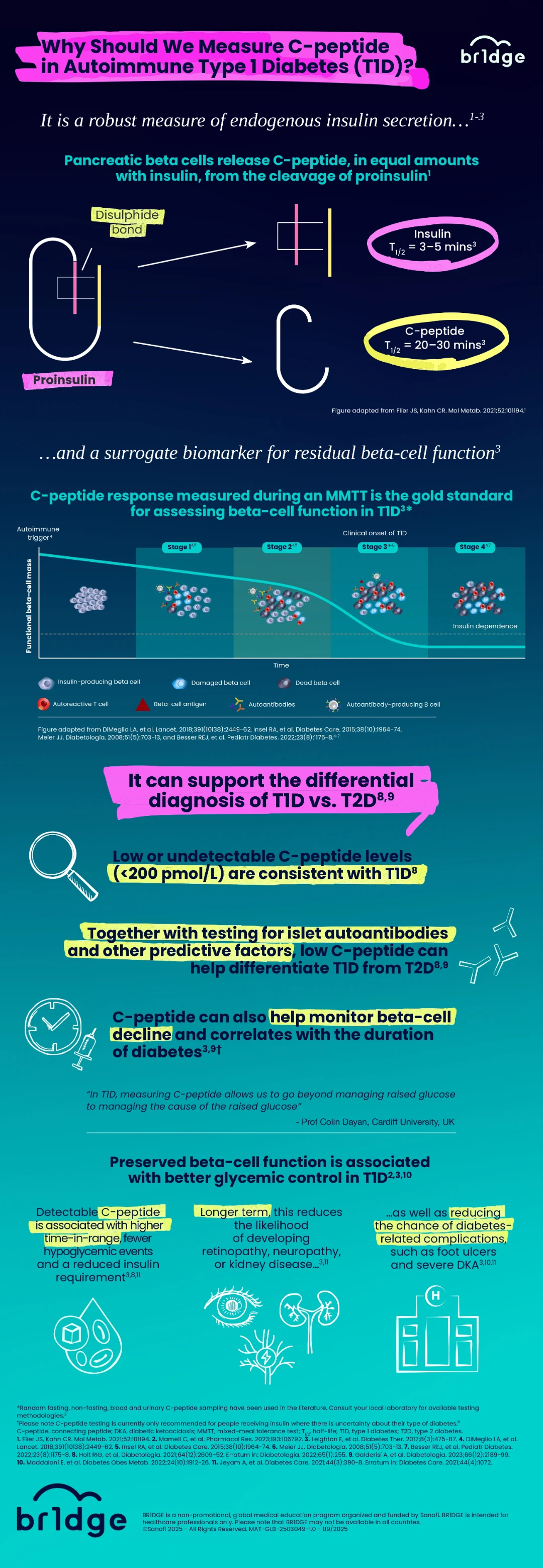
- Understand that C-peptide is a byproduct of insulin synthesis
- Recognize C-peptide’s role in understanding disease status in T1D
- Appreciate C-peptide’s potential as a diagnostic and prognostic tool
Chapter 4.3: Education and Psychosocial Support During Monitoring
This chapter will provide guidance on addressing the educational and psychosocial needs of individuals with early-stage T1D.
Learning Objectives
- Recognize the impact of detecting T1D IAbs on individuals and families
- Understand the role of structured monitoring visits in managing uncertainty following IAb detection
- Apply strategies to reduce anxiety in individuals navigating early-stage T1D

Learning Objectives
- Develop effective communication strategies to ensure accurate risk perception and encourage engagement with monitoring
- Understand ways to provide targeted counseling and reduce logistical barriers for families in T1D monitoring programs

Congratulations on completing BR1DGE Module 4: Monitoring the Progression of Autoimmune Type 1 Diabetes!

Current and emerging management of type one diabetes
This module explores current evidence-based management approaches for T1D and examines emerging therapeutic strategies that may modify the course of T1D

Burden of autoimmune T1D
This module explores the significant impact of T1D on individuals including psychosocial burden of early stage T1D, the burden of diagnosis at clinical onset and the importance of early detection and screening.
Early detection of autoimmune type 1 diabetes
This module focuses on methods and strategies for identifying T1D in its presymptomatic stages, emphasizing the benefits of early diagnosis